Ragas by time of day
In Hindustani music, most ragas have a time of day they belong to. This is called samay. Bhairav belongs to dawn, Yaman to early evening, Malkauns to the middle of the night. A few ragas belong to a season instead — the Malhar ragas to the monsoon, Basant to spring.
Nothing stops you from playing a dawn raga at midnight, and concert schedules ignore samay all the time. But musicians still feel the difference, and listening with the hour in mind is one of the quickest ways to start hearing what makes one raga unlike another.
Samay, in plain language
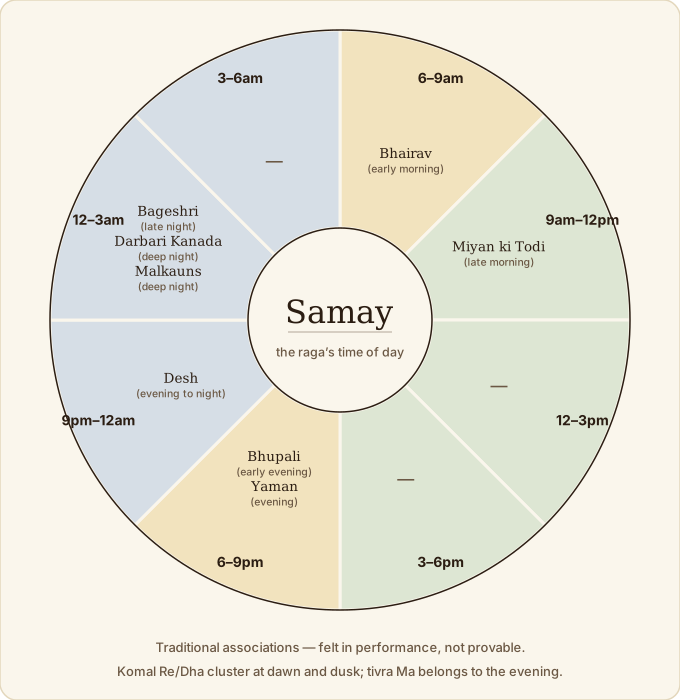
The traditional day is split into eight prahars of about three hours each, four for the day and four for the night. Ragas are placed in the prahar where their mood feels most at home.
What's the time, raga-wise?
Choose a prahar — a three-hour watch of the day — to see what belongs to it.
6–9am
- BhairavS r G M P d N S'
The reasons are partly felt and partly musical. A few patterns show up again and again:
- Dawn and dusk ragas often use komal (flat) Re. The two twilights — sandhi prakash, "the joining of light" — are full of ragas with a lowered Re, and often a lowered Dha too. They tend to sound grave, searching, or unsettled, like the light at those hours.
- Evening ragas often use tivra (raised) Ma. Yaman, Marwa, Purvi and Shree all lean on it, and it gives the evening its open, glowing quality.
- Late-night ragas often use komal Ga and Ni. Darbari Kanada, Malkauns and Bageshri live there — inward, slow, weighty.
These are tendencies, not laws, and there are exceptions to every one. Scale alone never decides a raga's time: Bhupali and Deshkar use the same five notes, but Bhupali is an evening raga and Deshkar a morning one, because of how each moves through those notes.
Morning ragas
The morning ragas move from the stillness before sunrise into the bright middle of the day.
- Bhairav — early morning. Komal Re and komal Dha against otherwise natural notes. Stark, devotional, grounded: the textbook dawn raga.
- Ahir Bhairav — just after sunrise. Bhairav's lower half with a softer upper half, which makes it gentler and more tender than its parent.
- Bilaskhani Todi — morning. Built almost entirely from komal notes, with a sense of grief that it carries from the story attached to its name.
- Alhaiya Bilawal — morning. Natural notes throughout, bright and cheerful — the morning in full daylight.
- Miyan ki Todi — late morning. Yearning and intricate, one of the most demanding ragas to play well.
- Jaunpuri — late morning. Serious and dignified, with a slight melancholy from its komal Ga, Dha and Ni.
Afternoon ragas
The afternoon is a quieter part of the raga day, but it has some of the most loved ragas in the repertoire.
- Bhimpalasi — afternoon. Warm and a little wistful, with soft komal Ga and Ni. It suits the heavy, slow hours after midday.
- Multani — late afternoon. Intense and serious, its komal Re and Dha and tivra Ma pointing towards the coming dusk.
Sunset ragas
Dusk is the second sandhi prakash, and its ragas have a particular gravity.
- Marwa — sunset. Komal Re and tivra Ma, and Sa played sparingly, so the raga never quite comes to rest. Restless, like the last light.
- Purvi — late afternoon into sunset. Both forms of Ma, with komal Re and Dha. Solemn and full.
- Shree — dusk. One of the oldest and most serious ragas, with long, deep glides between its notes.
Evening ragas
As darkness settles, the ragas open out.
- Yaman — evening, the first quarter of the night. Tivra Ma against otherwise natural notes. Expansive, warm and luminous: probably the most taught raga in Hindustani music, and a very good first raga.
- Bhupali — early evening. Only five notes, no Ma and no Ni. Bright, settled and calm.
- Pahadi — evening. A lighter raga with the feel of folk melody from the hills.
Night ragas
The first half of the night is where many of the romantic and lyrical ragas live.
- Bihag — night. Graceful and romantic, with a touch of tivra Ma in an otherwise natural scale.
- Hamsadhwani — the first quarter of the night. Five bright notes, joyful and quick on its feet.
- Khamaj and Jhinjhoti — the first half of the night. Light, lyrical, close to song.
- Desh — evening to night. Tender and longing, and also tied to the monsoon (below).
- Kafi — night. Komal Ga and Ni, gentle and folk-like, close to the music of spring festivals.
- Durga — late evening to midnight. Five notes, serene and quietly devotional.
Late-night ragas
After midnight the ragas slow down and turn inward.
- Bageshri — late night. Romantic and introspective, full of waiting.
- Darbari Kanada — deep night. Slow, weighty, with a heavy oscillation on its komal Ga that is famously hard to play with the right gravity.
- Malkauns — deep night. Five notes, all komal except Sa and Ma, intense and meditative.
And at the end of a concert, whatever the hour, many musicians close with Bhairavi. Its traditional time is morning, but it is so tied to the feeling of farewell that it is played last regardless.
Monsoon and seasonal ragas
Some ragas belong to a season rather than an hour. This is called ritu, and it sits alongside samay rather than replacing it.
- The Malhar family — Miyan ki Malhar, Megh Malhar, Gaud Malhar and others — belongs to the monsoon. Their phrases are said to call the rain, and in the rainy season they are played at any hour.
- Desh is closely tied to the monsoon too, and many songs about the rains are set in it.
- Basant, Bahar and Hindol belong to spring — Hindol is named for the swing, and carries its rocking motion.
The Malhar ragas are not yet on Sitarpedia's raga pages; Desh is, and is a good place to start hearing the monsoon mood.
Which raga for the evening?
If you want one answer: Yaman. It is the classic evening raga, its notes are easy to find on the sitar, and it is the raga most teachers start with. If you want a second, try Bhupali — five notes, nothing to get wrong, and the same calm early-evening feeling.
For the morning, start with Bhairav. For late at night, Malkauns or Bageshri.
Listening with the hour in mind
Samay is not a rule anyone enforces. It is better understood as part of a raga's identity, like its notes or its pakad. A simple experiment shows why it lasted: play or listen to Bhairav near sunrise and Yaman after dark, and notice whether each one lands differently than it would at an arbitrary hour. Then try them the other way round.
For the idea of a raga itself, see what is a raga; for the full theory of the prahars, see the lesson raga and time.