What is a raga?
A raga is the framework a piece of Hindustani (North Indian classical) music is built on. It starts with a set of notes, like a scale, and then adds rules: which notes are important, how to move between them, which phrases identify it, how each note is ornamented, even what time of day it belongs to. A musician improvising in a raga is free to invent — but only within those rules. Two ragas can use the same notes and still sound like completely different music.
Hear two ragas with almost the same notes
Hear the shape of the raga
Drag across the line — or tap a note — to hear the ascent and descent one note at a time.
Drag across each line to play it. Yaman uses all seven notes, with a raised fourth (tivra Ma). Bhupali uses five of the same notes and leaves out Ma and Ni. Both belong to the same parent scale. They don't sound like variations on each other; they sound like two different moods.
Raga vs scale
A scale is a set of notes in order. A raga is a set of notes plus:
- A hierarchy. Every raga has a most important note, the vadi, and a second, the samvadi. Phrases rest on them and return to them. A scale treats all its notes equally; a raga doesn't.
- A way of moving. The ascent (aroha) and descent (avaroha) are often different. Some ragas skip a note going up but use it coming down, or zigzag rather than climbing straight.
- Signature phrases. The pakad ("grip") is a short phrase that identifies the raga, the way a few notes can identify a song.
- Ornament rules. Which notes are approached with a slow glide (meend), which are swayed, which are touched only lightly. Get them wrong and you're playing the right notes in the wrong raga.
- A time and a mood. Many ragas are traditionally performed at a particular time of day or season, and each is associated with an emotional colour, its rasa.
The course's raga vs scale lesson takes each of these apart with Western comparisons.
The notes: swaras
Hindustani music names its seven notes Sa Re Ga Ma Pa Dha Ni, relative to a tonic, Sa, that the performer chooses. Four of them have a flat (komal) version, written lowercase in Sitarpedia: re, ga, dha, ni. Ma has a sharp (tivra) version instead. Sa and Pa never change. That makes twelve positions in the octave, the same twelve as the Western chromatic scale.
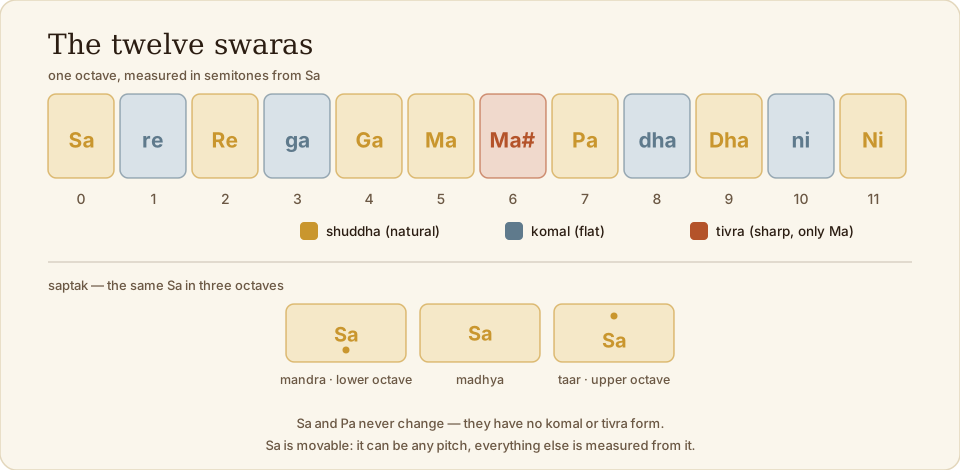
A raga chooses from these twelve — usually five, six or seven of them — and the drone holds Sa (and usually Pa) underneath the whole performance.
A raga's signature phrase
Here is the pakad of Darbari Kanada, a
grave, late-night raga. The ~ marks a slow sway on the note, and the >
a glide:
Play the same notes without the sways and a listener who knows the raga starts to hear a different raga from the same parent scale, such as Jaunpuri. That's what "a raga is more than its notes" means in practice.
Parent scales: thaats
Hindustani theory groups ragas under ten parent scales called thaats. One, Bilawal, is the Western major scale; Kalyan is the Lydian mode; others have no Western name. The thaat tells you which notes a raga draws on, not how it behaves — Yaman and Bhupali share the Kalyan thaat. The thaat lesson lists all ten.
Time of day
The tradition assigns many ragas a time: Bhairav at dawn, Yaman in the early evening, Darbari Kanada and Malkauns in the deep night. This system, called samay, is honoured in concerts more than it's enforced in practice — you can practise Bhairav in the evening — but it shapes the character the ragas are played with.
How a raga becomes a performance
A sitar performance of a raga usually unfolds in stages: a slow, unaccompanied alap that introduces the notes one by one; a rhythmic jod and fast jhala; then a fixed composition, a gat, with the tabla, improvised around and ending in tihais. The same raga can last five minutes or an hour.
How many ragas are there?
Hundreds are in active use, and many more exist in old texts or in particular families of musicians. A typical performer has a few dozen in depth. Beginners usually start with Yaman, Bhupali or Bhairav: clear rules, distinctive sound, few traps.
Where to start
Pick one raga and live in it for a few weeks. Its page in Ragas plays its ascent, descent and pakad on a sitar; the course's lesson on choosing your first raga helps you pick. If you come from Western music, the sitar for guitar players guide translates the rest of the vocabulary.