What is a tihai?
A tihai is a phrase played three times in a row, timed so that the very last note of the third repetition lands exactly on sam — beat one of the rhythmic cycle. The word comes from teen, three. It's the moment in a sitar and tabla performance when both players hit the same beat together and the audience reacts, often before the phrase has finished.
See it, then hear it
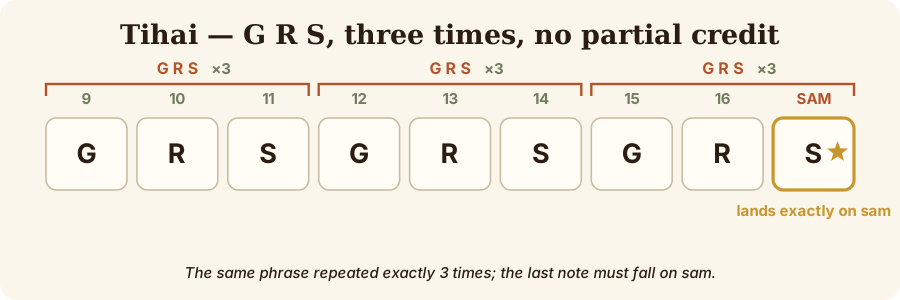
Here's about the smallest tihai there is: the three-note phrase G R S, starting on beat 9 of the sixteen-beat cycle Teentaal.
Play the tihai
The tabla counts in from sam; watch the last S land on the next sam.
Beats 9 to 16 are eight beats; add the next sam and that's nine. Three repetitions of a three-note phrase fill nine beats exactly, so the third S falls on sam.
The arithmetic
Every tihai is the same small equation. A phrase of length p is played three times, with a gap of length g between repetitions (the gap can be zero):
3p + 2g = the beats from where you start to sam, counting sam itself
There are only two gaps, because nothing follows the third phrase — it ends on sam.
Worked example: a full-cycle tihai in Teentaal. Start on beat 1 and land on the next sam: that's 16 beats plus the landing beat, 17. Choose a phrase of 5 beats and a gap of 1: 3 × 5 + 2 × 1 = 17. So:
| Beats | What's played |
|---|---|
| 1–5 | Phrase |
| 6 | Gap |
| 7–11 | Phrase |
| 12 | Gap |
| 13–16, then sam | Phrase — its fifth note is sam |
Change the phrase length and the gap has to change too. A 4-beat phrase can't fit 17 three times without a gap of 2½, so performers either stretch a note, start somewhere else, or pick a different phrase. That's the craft.
Two kinds of tihai
- Bedam (breathless) — no gaps. The phrase runs straight into itself three times. G R S × 3 above is bedam.
- Damdar (with breath) — a pause or held note between repetitions, as in the full-cycle example.
There's also the chakradar, a tihai made of tihais: a phrase that is itself a tihai, played three times, so the landing comes after nine statements. It's a common showpiece in tabla solos and at the climax of a fast gat.
Where tihais happen
- At the end of a piece, often a long, elaborate one.
- At the end of an improvised phrase, to land back on sam before the next idea — a quick way to show you've kept count.
- Between sections, for example from a slow composition into a faster one.
- In conversation with the tabla. In sawal-jawab (question and answer), sitar and tabla trade phrases, and tihais close the exchanges.
Why it works on a listener
Rhythm in Hindustani music is cyclical: the cycle keeps turning and sam is where it begins again. A tihai builds expectation — once the listener hears the phrase twice, they know a third is coming and feel where it should land. When it lands, the tension resolves. Miss by half a beat and the effect vanishes. There's no partial credit, which is why players practise tihais as fixed phrases rather than inventing every one on the spot.
Tihais at different scales
The same idea works at almost any size:
- Tiny: a three-note phrase, as above — barely two seconds.
- One cycle: a five-beat phrase with gaps, filling all sixteen beats of Teentaal.
- Several cycles: a long, elaborate phrase stretched across two or three cycles, used as a grand ending.
- In other taals: in Jhaptaal's ten beats or Rupak's seven, the arithmetic changes but the rule doesn't — three times, landing on sam.
Not every tihai has to land on sam. Some players aim a tihai at the start of the composition's fixed phrase (the mukhda), so the tihai leads straight back into the melody instead of stopping on beat one.
Tihai vs Western cadence
The nearest Western idea is a cadence — the chord progression that says "this is the end." A tihai does the same job with rhythm instead of harmony, which suits music that sits over a single drone and doesn't change chords. The other close cousin is the drum fill that brings a rock band back to the downbeat; a tihai is a fill with rules.
Make one yourself
Pick any three-note phrase from a raga you know — the aroha of Bhupali gives you plenty — and count it in from beat 9 of Teentaal, as in the example. Then try starting on beat 1 with a five-note phrase and a one-beat gap. The Tihai Builder game runs these against a live tabla cycle and tells you if you landed. If the cycle itself is new, the Teentaal lesson comes first; tihais sit inside other ornamental and rhythmic ideas covered in the what is gamak guide and the course.