The mizrab: how to wear it, and which size
The mizrab is the sitar's plectrum: a small piece of bent steel wire worn on the tip of the right index finger. Every note you play on the main string starts with it, so a mizrab that fits well — and sits at the right angle — makes the instrument easier to play and better to hear.
What it looks like
A mizrab is one length of stiff wire, bent into a loop that wraps around your fingertip and a short, flat-ish striking edge that extends just past the end of the finger. It looks a little like a tiny paperclip. They're inexpensive, and most players keep two or three.
How to wear a mizrab
- Index finger of the right hand. That's the standard. (Left-handed players with a left-handed sitar wear it on the left.)
- Slide it on so the loop sits around the fingertip, just behind the nail, and the striking end points past the tip of your finger, along the line of the finger.
- Check the overhang. The wire should extend a few millimetres beyond your fingertip — enough that the wire, not your skin, meets the string.
- Check the fit. Snug enough that it doesn't move when you strike, not so tight that your fingertip goes pale or throbs. A mizrab leaves a faint dent after practice; it shouldn't hurt.
- Adjust it by gently squeezing the loop closed or easing it open with your fingers. Wire bends; small adjustments are normal.
Mizrab sizes
Mizrabs are sold in a few sizes — usually small, medium and large, or by a number. There's no universal scale, so:
- Measure your finger. If you can, try one on. The loop should close around your fingertip at the first joint without pinching.
- When in doubt, buy two sizes. They're cheap, and fingers swell a little in warm weather or after long practice.
- Children and players with slim fingers often need the smallest size, or a mizrab squeezed narrower.
- Thicker wire sounds louder and brighter and takes longer to get used to; thinner wire is gentler on the finger.
The two strokes
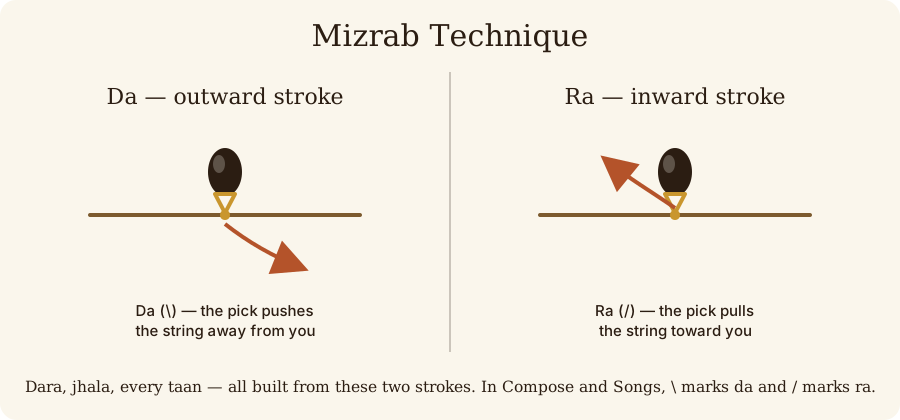
Everything the mizrab plays is built from two strokes:
- Da — the outward stroke, the finger pushing the string away from you. The stronger stroke, used on most main beats.
- Ra — the inward stroke, the finger pulling back toward you. Lighter.
Alternate them and you get dara, the basic unit of fast playing:
Sitarpedia writes da as \ and ra as / after a note. The sampled tone
makes da a little brighter than ra; a real mizrab makes the difference
clearer.
Where the hand goes
Your right forearm rests across the top of the gourd. Many teachers have the thumb rest lightly on the edge of the fingerboard where it meets the gourd, as an anchor, so the index finger strikes from a steady point. The motion comes from the finger and wrist, not the elbow. Strike the main string over the gourd, between the end of the fingerboard and the main bridge. The posture guide shows the whole position.
Breaking in a new mizrab
A new mizrab feels stiff and strange for the first week. Wear it for short sessions and take it off between them. If the striking end feels sharp or catches the string, players sometimes smooth it very lightly with fine emery paper — just the edge, not the shape. And keep your old mizrab: one that has moulded to your finger over months is worth more than a new one, and it's useful to have a spare when one goes missing, which they do.
Mizrab, pick or fingers?
You might wonder whether a guitar pick, or bare fingers, would do. They won't sound the same. The steel wire gives the sitar's main string its bright, focused attack, and lets it ring loudly enough to drive the sympathetic strings. A guitar pick sounds soft and dull on a sitar, and bare fingers wear quickly on thin steel. Start with the mizrab and it soon feels like part of your hand.
Common problems
- The mizrab spins or slips. Too loose. Squeeze the loop slightly.
- Your fingertip is numb. Too tight. Ease it open and take it off between sessions.
- A clicking or scraping sound. The mizrab is hitting at a flat angle, or your fingertip is touching the string. Angle the wire so only its tip meets the string.
- Da is loud and ra is almost silent. Common at first. Drill dara slowly until both are even.
- A sore spot behind the nail. Normal for the first few weeks. Short sessions; the skin toughens.
Drills to start with
- Steady dara on one open string, one stroke per beat, for two minutes. Aim for evenness, not speed.
- Da only, then ra only, to hear the difference between them.
- Dara with the beat, against a slow tabla cycle — the stroke play-along plays one and lights each stroke as it falls.
The course's mizrab technique lesson builds these into four drills with tempos to work up through. If you haven't got a sitar yet, the buying guide covers what to look for — and a good seller will include a mizrab or two.