How to change sitar strings
Changing a sitar string is closer to changing a guitar string than to the setup work that needs a technician. It's fiddly the first time — the string runs over two bridges, a bead and a nut, and sometimes through the neck — but it's a routine skill worth having. Here's how.
Does the string actually need replacing?
Signs that it does:
- A dull, dead tone on one string that doesn't match its neighbours, even freshly tuned. Steel strings lose brightness gradually.
- Fraying, flat spots or rust, especially where the string crosses the jawari (the main bridge). That's the highest-wear point.
- It won't hold tuning, when it used to.
- It broke. Obviously.
A buzz that follows one string up and down the neck can be a worn string. A buzz on every string, or one tied to a single fret, is more likely the jawari or a fret — see the maintenance guide.
What you need
- The right replacement string. Sitar strings are sold in sets and singly, by gauge. The main melody string (baj tar) and the chikari are plain steel; the lower drone strings (jor, pancham, kharaj) are often bronze or copper; the taraf are thin steel. Match the gauge of the string you're replacing — measure it, or note it from the packet. A seller who knows sitars can tell you the usual set for your style of instrument.
- Small pliers or a string cutter.
- A soft cloth to rest the instrument on.
- A tuner. The one in Practice, or the one built into the tuning guide.
Changing a main playing string
- Note the route. Before removing anything, look at how the old string runs: from the tailpiece (langot) at the bottom of the tumba, through its bead (manka), over the jawari, along the neck, over the nut, to its peg. A phone photo saves guesswork.
- Slacken and remove the old string. Turn the peg to loosen it, unwind it, and unhook it from the tailpiece. Keep the bead.
- Make a loop. Sitar strings are usually anchored at the tailpiece with a small loop: twist the end around itself several times, tightly, to form a loop that hooks on.
- Thread the bead onto the string above the tailpiece, in the same place as before.
- Lay the string over the jawari in its groove, then along the neck and through its slot in the nut.
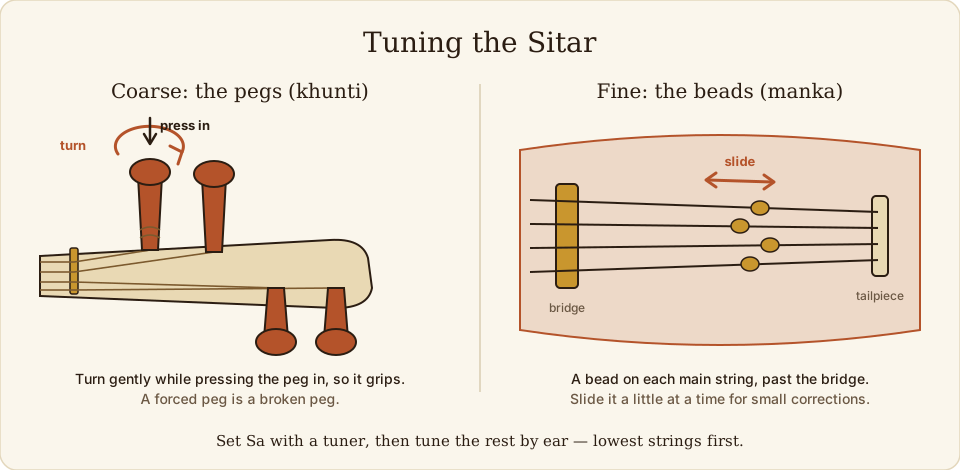
- Wind it onto the peg. Push the end through the hole in the peg, leave enough slack for two or three turns, and wind so the string comes off the peg on the same side as before. Press the peg inward as you turn so it grips.
- Bring it up to pitch slowly, checking the string stays in its grooves on the nut and jawari. Tune with the tuner, then fine-tune by sliding the bead.
- Trim the excess a little past the peg.
Changing a taraf (sympathetic) string
Taraf strings are thinner and the route is different: they run from the tailpiece over the small taraf bridge, under the frets, and through a small hole in the side of the neck to their pegs.
- Note which hole and peg the old string uses — the order matters, since each taraf is tuned to a different note.
- Remove the old string from the peg and tailpiece.
- Hook the new string at the tailpiece and lay it over its notch on the taraf bridge.
- Feed it under the frets toward its hole. A thin wire or a stiff paper strip helps guide it through the hole if it won't find its way.
- Wind it onto its peg and tune it to its note for the raga.
The order, if you're changing more than one
Taraf first, then chikari, then main strings. The taraf sit underneath everything else, so doing them first avoids loosening strings you've already tuned. And change strings one or two at a time rather than all at once: removing every string releases the tension on the neck and bridges, and the jawari and frets may need re-settling afterwards.
After restringing
New strings stretch. Expect a fresh string to go flat over and over for the first few days; retune it each time and it settles. Some players gently pull a new string away from the neck a few times to speed this up. Either way, don't restring on the day of something important — do it several days before.
If the new string still sounds wrong, the problem may be the jawari. A string slowly wears a groove into the bridge, and replacing the string doesn't remove the groove. That's a job for a technician, covered in the course's lesson on jawari and setup.
How often?
There's no fixed schedule. A main string played daily may need replacing every few months; taraf strings last much longer because you never touch them. Change a string when it shows the signs above, not on a calendar. Keep a spare main string and a couple of spare taraf in the case. Once it's on, the tuning guide takes you through bringing it to pitch with the rest.